Small group activities for preschool: how to pick one and plan it
Jenn Bell
A good small group activity doesn't have to be clever. It has to be picked for the handful of children at your table, ready before they sit down, and given a real beginning and a real end.
What small group is, and what it isn't
Small group time is when the class splits into smaller groups, and each adult takes a handful of children for a planned activity. In the programs I taught in, it happened every day. My groups ran 3 to 6 children; how many you have, and how long you get, depends on your program. My group was assigned to me for the year, and they were the families I met with at conferences, so small group was where I really got to know them.
It's different from free choice, where everyone does their own thing. At small group we do it together, so part of the time a child is watching a friend's turn. That's okay. Waiting, noticing what someone else needs, sharing the table: that's a big part of what small group is for.
How to pick a small group activity
To decide what to do at small group, I planned in advance and took the idea from one of four places:
- What the children were into right then.
- The theme we were working on that week.
- Something a child was working on. Small group gave her a chance to try it with a few friends and me right there.
- What I hadn't seen yet. I kept child assessments for my group (in my programs, that was California's DRDP). Sometimes my observation notes showed a skill I hadn't seen yet, so I'd plan a small group where I could.
A real one: The Color Kittens at the kidney table
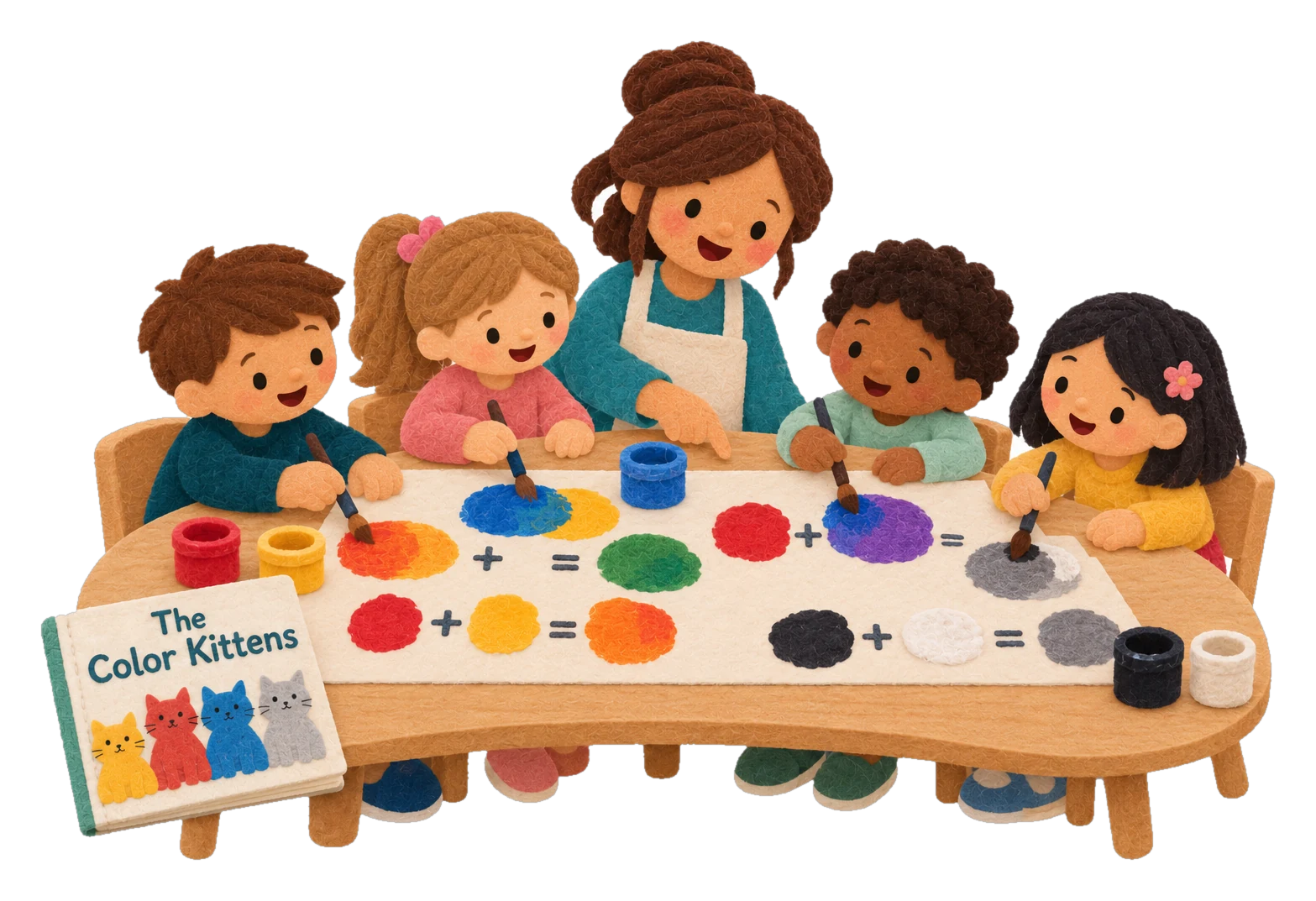
Here's a real small group from my early days of teaching: five children, a mix of 3-, 4-, and 5-year-olds, reading The Color Kittens and mixing paint at the kidney table. Small group came once a day: free choice as children arrived, then circle time, then small group.
The plan: read the book, by Margaret Wise Brown, then mix colors on a poster board to see which combinations work, and label each one.
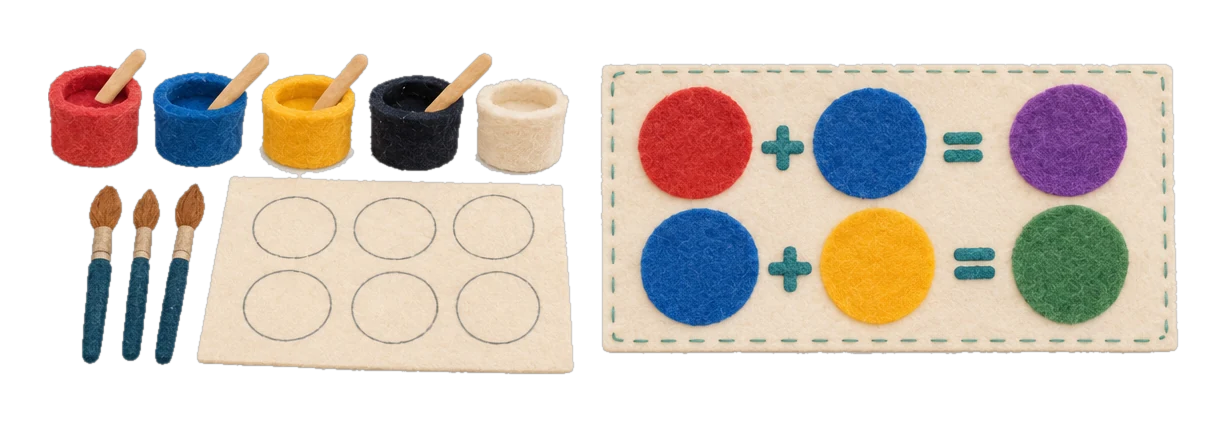
Before anyone sat down, everything was out. The book. A paintbrush for each child. Red, blue, and yellow paint, plus some black and white, each in its own container with its own plastic spoon. A poster board with circles ready for the colors, a printed picture of the book's cover, and our names on it. A Sharpie. I set it up on my break before group, or during cleanup. If children sit down while you're still pulling things together, it's a harder start.
Then I read the book. I always read a book ahead of time, so I know where the big moments are. I turned it to each child, kept my voice loud enough but calm, asked questions as we went, and when a child guessed, I looked at her and said her guess back to her.
After the book, I picked two children, and each picked a color, spooned it onto the poster board, and they mixed them with their brushes. We guessed first (what do you think this will be?), decided together what color it made, and I wrote it beside the circle: red and blue equals purple. I could add the names of who picked which. The other three children watched, guessed, and named it with us, then took their turns. At the end, each child picked a color and we mixed them all into one group color.
At one point two children both picked black. I could have said, "Well, that's just black." Instead I said, "Oh, let's see." The whole point was the process: cause and effect, seeing what happens. I never want to discourage a child's idea when a little experimenting will show her.
Afterward, the poster went up where the class could see it: work they did together, and something to be proud of.
How to plan it: the five pieces I use
I plan a small group in five pieces: centering, focusing, hands-on or movement, sharing, and closure. I learned these five as a student teacher and used them for the rest of my career.
Centering: how will you gather them, and where? I called names one by one from circle time, and each child came over to my table, already set up.
Focusing: what can they expect? Short and clear: "I'm going to read a book, and then we're going to mix some colors." Too much detail up front and they lose interest. They want to get into it.
Hands-on or movement: does every child have a part? If I'm showing them and they aren't doing anything, that isn't small group. Here every child picked, mixed, guessed, and named.
Sharing: what will they share? Thoughts, ideas, materials, space. At this table they shared the paint, the spoons, the poster board, and their guesses.
Closure: how will they know it's over? Not "all right, done, everybody up." Cleanup came first. Then, while they were still focused enough to hear it, I told them what came next: "After this, one by one, we'll push in our chairs and walk outside for free choice." Then our cheer: hands in the middle, one on top of the other like a team, and as we lifted them we said, "Mixing colors is over!" Whatever the activity, that's how we always ended (sometimes "Group time is over!"). It was the cue that group time was officially done.
What didn't go the way I planned
Four things didn't go the way I planned, and each one taught me something.
I didn't make clear enough what to expect. One of the boys got really upset when he realized we were mixing together on one poster, not each in our own space. I had mentioned it, but I must have said it too fast. In the moment, the job was to keep my cool. Next time, I'd say it clearly before we started mixing so nothing was a surprise, and plan for him so he'd feel more secure. Keep what you tell them short, and still say the thing that might surprise someone.
I forgot aprons. Paint, and no aprons. Once you're in it, getting up from the table changes the whole feel of the group, and it scrambles you as a teacher too. Go over everything before it starts.
I should have shown them first. Some children took a minute to understand the mixing and how we'd take turns. A quick demonstration before diving in would have helped.
One child mostly watched. She was quiet through most of the group, and that's okay. Maybe it was her temperament, maybe an off day, maybe she'd rather observe. Instead of beating yourself up, accept it and learn from it. Next time, I'd think about what lights her up, at free choice or in her own life, and plan a small group around it, without singling her out or telling the group why I chose it. Encourage without pushing, so she finds her voice and feels part of the group; that's how small group time builds self-esteem.
And if something isn't landing, follow the children's cues. It's okay to wrap up a little early instead of forcing it.
Small group is a learning experience for the teacher too. Sometimes I had sticky notes at the table for observation notes, and afterward I'd reflect: where each child is, what they might need more support with, and where I could have said two more words or slowed down.
Who has the rest of the class
In my programs, my co-teacher or an aide ran their own small group at the same time, with their own assigned children. A co-teacher planned her own. Aides and student teachers, I encouraged to plan theirs, and I gave feedback after. I liked each of us getting to know our group our own way.
We talked constantly, especially before conferences and assessments. Sometimes I'd suggest something like, "Maybe do an obstacle course at small group, if you don't have many large motor observations for that child yet."
If you're a student teacher, small group is where confidence grows: once you know a few children well, that carries into circle time and the rest of the day.
A few questions teachers ask
How many children should be in a preschool small group? It depends on your program. Mine ran 3 to 6 children.
What's the difference between small group and circle time? Circle time is the whole class together. Small group is the class split up, each adult with her own handful of children, and in my programs it came right after circle. Every child has a hands-on part, and it's the same group all year.
Do you need another adult at small group? Not usually. In my programs, small group was almost always me and my group, because the other adults were each running their own small group at the same time. I only had a second adult when I was student teaching, when I was training my own student teacher, or when a child in my group had a one-on-one aide.
What if a child mostly watches? That's okay. Some children would rather observe, and some days are off days. If it happens consistently, that's when to ask what you know about this child, and plan with that in mind.
One last thing
Most of what made that group work happened before the children sat down: picking it for those five, having everything out, knowing how it would start and end. For me that lived in my head and my notes.
Picking it is yours, because you know your group. Putting the plan on paper is where Planella comes in: type in your small group idea and it lays out the materials, setup, what to watch for, and how to document it for conferences.
Small group ideas to start from: "Color mixing with eyedroppers" in process art activities, "Scented playdough made at the table" in sensory bin and water table ideas, and "Graph what everybody picked" in counting, sorting, and math activities. Making playdough and graphs were two of my favorites at small group. And if you plan without a set curriculum, here's how I plan a week from the children's interests.
Written by Jenn Bell, who spent over a decade teaching preschool. About Jenn →